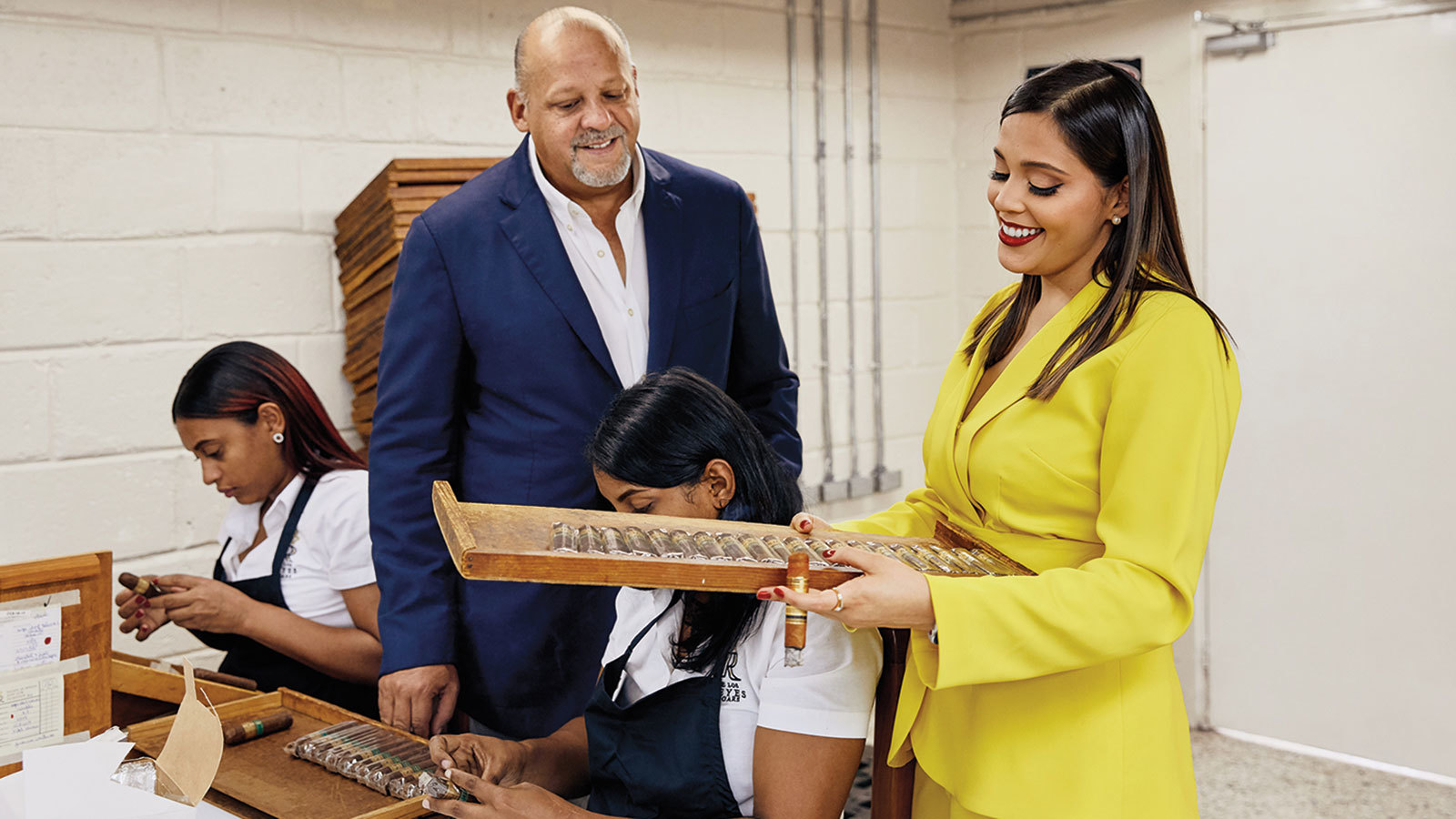
 Augusto Reyes and Nirka Reyes at De Los Reyes factory in Santiago, DR, 7/30/19[/caption]Q: What other changes did you make?
A: We also downsized. That was sad too, but it was critical. He was making the Patoro brand since 2001. It was a European line. Patoro was our quality standard. I wanted all my cigars to be like that. That became the production standard for the factory.Q: How did you raise the standard?
A: In the cigar world, you don’t pay by skill. You pay by production quantity. I wanted to change that. I wanted everyone to roll with the same quality. Incentive changes. We don’t pay for how many cigars each roller makes.Q: So the better the roller the more money they make?
A: Yes. They have a baseline on production, but the incentive they used to get for quantity is now for quality.Q: That sounds like a big change. How did the rollers like it?
A: Some of them left. Most of them stayed. I wasn’t doing millions of cigars anymore. Maybe 1.2 or 1.3 million cigars. That was in 2013.Q: You went from making 13 million cigars a year down to 1.3 million?
A: Yes.Q: What did your father think about the drop in production?
A: He was very supportive. He agreed. I’m always going to have a cigar factory. We put out the Don Julio brand. Swisher owned the trademark and they gave it to us, so this was named after my great grandfather to honor our past. It was a big deal to honor my past. We had two booths that year [at the trade show] in 2013 to introduce Don Julio.Q: How many cigars do you produce a year?
A: Last year, 2.2 million, including private brands.Q: What’s the percentage of your own brands verses the contract brands you produce for other people?
A: Thirty percent is ours. Everything else is private.Q: Are you trying to get back to the old production numbers?
A: It’s a long-term plan. We hired engineers to figure out how to improve processes, improving aging techniques for example, and changes in our humidity. My brother had distribution in Miami, but we had to close it because I’m not shipping millions of cigars into the U.S. Now, we ship directly to the retailer from the factory with UPS. And we pay for the shipping.Q: Is your father completely hands-off?
A: No. Even though I manage De Los Reyes, we’re still a family board, so I have to present to my dad and my brother.Q: What’s your flagship brand?
A: Saga. I wanted something that portrays the stories and the heritage of cigars. That’s when Saga came to mind. My dad hated the name [laughs]. In Dominican slang, you call a bad baseball player “saga.” It’s a short name and people can say it easily in any language.Q: What year did Saga come out?
A: That was 2014. The Saga Golden Age came out with all Dominican tobacco. It has a Corojo 2006 Dominican wrapper, Dominican San Vicente binder and original Piloto Cubano seed tobacco in the filler. A lot of people don’t use Dominican wrapper. My uncle is very big on using Dominican seeds.Q: Your uncle as in Leo Reyes, the grower of Dominican tobacco?
A: Yes. He is the most passionate person about tobacco that I know. He inspired me to change everything to improve and to always keep improving. If he didn’t continue to grow the Piloto I wouldn’t have Golden Age. Working with family is difficult and I had to gain his respect. I am his client now. He’ll show me a seed and I know he has other customers, but I want to be first, so I have to negotiate with him.Q: How many different tobacco types does he grow?
A: In Cuban seeds alone, he grows about 17 different varieties. It’s a privilege to use wrappers grown in the same fields that my great grandfather grew tobacco on. It gives me the continuity of six generations and it’s an important connection. I never travel during tobacco season and I’m sad when it’s over. That connection makes all the difference. I know on what exact field the tobaccos come from and I know how my uncle processes the tobacco. When I buy from other growers, I have to do my own processing of the tobacco.Q: You changed the name of your company from Corporación Cigar Export (CCE) back to De Los Reyes. Why?
A: I never liked the name. We’re changing what we are as a factory and as a team. I didn’t like the logo either. My dad bought the free zone with that name and he just stayed with it. I remember our original factory in Jacagua. It wasn’t fancy at all, but it was beautiful. I wanted that feeling so I went back to the first name. That was in 2015. I used the crown for the logo which was taken from my family’s crest.
Augusto Reyes and Nirka Reyes at De Los Reyes factory in Santiago, DR, 7/30/19[/caption]Q: What other changes did you make?
A: We also downsized. That was sad too, but it was critical. He was making the Patoro brand since 2001. It was a European line. Patoro was our quality standard. I wanted all my cigars to be like that. That became the production standard for the factory.Q: How did you raise the standard?
A: In the cigar world, you don’t pay by skill. You pay by production quantity. I wanted to change that. I wanted everyone to roll with the same quality. Incentive changes. We don’t pay for how many cigars each roller makes.Q: So the better the roller the more money they make?
A: Yes. They have a baseline on production, but the incentive they used to get for quantity is now for quality.Q: That sounds like a big change. How did the rollers like it?
A: Some of them left. Most of them stayed. I wasn’t doing millions of cigars anymore. Maybe 1.2 or 1.3 million cigars. That was in 2013.Q: You went from making 13 million cigars a year down to 1.3 million?
A: Yes.Q: What did your father think about the drop in production?
A: He was very supportive. He agreed. I’m always going to have a cigar factory. We put out the Don Julio brand. Swisher owned the trademark and they gave it to us, so this was named after my great grandfather to honor our past. It was a big deal to honor my past. We had two booths that year [at the trade show] in 2013 to introduce Don Julio.Q: How many cigars do you produce a year?
A: Last year, 2.2 million, including private brands.Q: What’s the percentage of your own brands verses the contract brands you produce for other people?
A: Thirty percent is ours. Everything else is private.Q: Are you trying to get back to the old production numbers?
A: It’s a long-term plan. We hired engineers to figure out how to improve processes, improving aging techniques for example, and changes in our humidity. My brother had distribution in Miami, but we had to close it because I’m not shipping millions of cigars into the U.S. Now, we ship directly to the retailer from the factory with UPS. And we pay for the shipping.Q: Is your father completely hands-off?
A: No. Even though I manage De Los Reyes, we’re still a family board, so I have to present to my dad and my brother.Q: What’s your flagship brand?
A: Saga. I wanted something that portrays the stories and the heritage of cigars. That’s when Saga came to mind. My dad hated the name [laughs]. In Dominican slang, you call a bad baseball player “saga.” It’s a short name and people can say it easily in any language.Q: What year did Saga come out?
A: That was 2014. The Saga Golden Age came out with all Dominican tobacco. It has a Corojo 2006 Dominican wrapper, Dominican San Vicente binder and original Piloto Cubano seed tobacco in the filler. A lot of people don’t use Dominican wrapper. My uncle is very big on using Dominican seeds.Q: Your uncle as in Leo Reyes, the grower of Dominican tobacco?
A: Yes. He is the most passionate person about tobacco that I know. He inspired me to change everything to improve and to always keep improving. If he didn’t continue to grow the Piloto I wouldn’t have Golden Age. Working with family is difficult and I had to gain his respect. I am his client now. He’ll show me a seed and I know he has other customers, but I want to be first, so I have to negotiate with him.Q: How many different tobacco types does he grow?
A: In Cuban seeds alone, he grows about 17 different varieties. It’s a privilege to use wrappers grown in the same fields that my great grandfather grew tobacco on. It gives me the continuity of six generations and it’s an important connection. I never travel during tobacco season and I’m sad when it’s over. That connection makes all the difference. I know on what exact field the tobaccos come from and I know how my uncle processes the tobacco. When I buy from other growers, I have to do my own processing of the tobacco.Q: You changed the name of your company from Corporación Cigar Export (CCE) back to De Los Reyes. Why?
A: I never liked the name. We’re changing what we are as a factory and as a team. I didn’t like the logo either. My dad bought the free zone with that name and he just stayed with it. I remember our original factory in Jacagua. It wasn’t fancy at all, but it was beautiful. I wanted that feeling so I went back to the first name. That was in 2015. I used the crown for the logo which was taken from my family’s crest.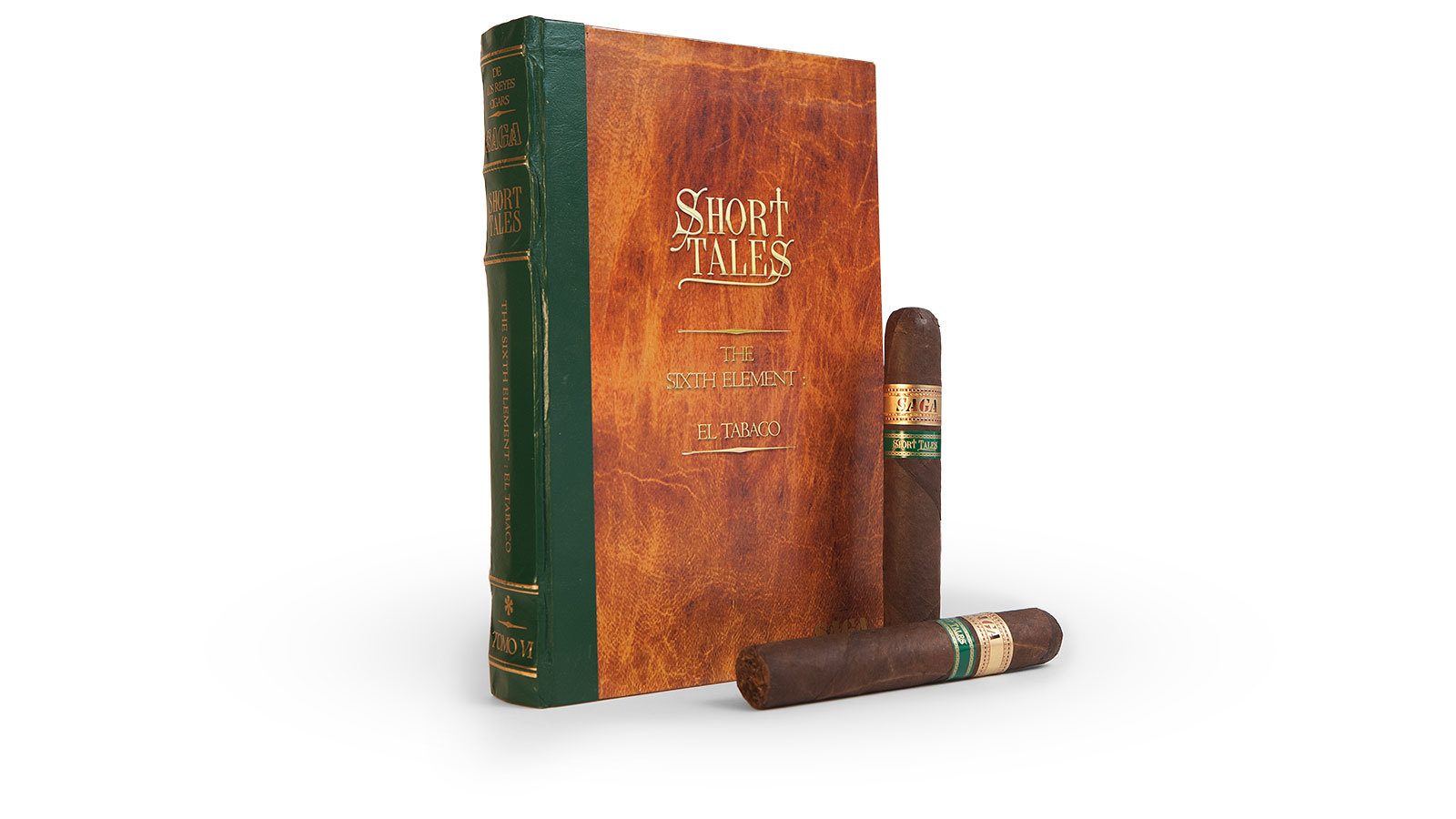 Q: Let’s talk about the Saga Short Tales brand.
A: Sagas are big stories. But then there are little stories. We wanted to make something unique, so we decided to make the box look like a book. The first volume of Saga Short Tales is called Tales of the High Primings. It came out in 2016 and we needed a strong cigar to kill the myth that we don’t make powerful cigars in the Dominican Republic. I went back to the high primings because of its power. For us, strength means that you feel it in your body, but there is still plenty of stimulation on the palate, so that you still detect the sweetness.Q: How did the market respond to the Saga Short Tales?
A: That’s been our game changer. They love the book. It sold out fast because people wanted to buy the full box. After they bought the first one, they want the collection. We’re trying to have every profile. We haven’t done a mild one yet. Not sure if we’re going to do that.Q: How many volumes do you have?
A: We’re up to six now. We plan on 10. Each one is a different blend and different size. A different story.Q: What’s the production for each Saga volume?
A: We start with 50,000 cigars. If inventories get down to a certain level, we start production again.Q: Do you think getting market share in the U.S. is difficult?
A: It is. You look around and there’s a new factory opening up every day. You’d think that with the FDA people would be scared, but apparently not. So many lines come out every year. And bigger companies have strategies to take up shelf space.Q: As a small company, what are your thoughts on the FDA regulations?
A: It feels like a very intentional thing, like they want us to be the generation that ends tobacco smoking. Not all tobacco products are the same. Cigarettes and smokeless tobacco are so different from cigars. They’re trying to regulate something that can never have one standard. It’s impossible. Are we going to chemically engineer a leaf so that every leaf gives the same amount of nicotine? It’s an attack on our culture, and they’re not trying to understand it. I accept that businesses have to be regulated, but we should have some air.Q: What would FDA regulation mean for your company?
A: Some products would be safe because we have predicate brands, but it’s going to limit creativity. What can I do to make a substantial equivalent? It will be playing chess with the government.Q: What’s it like being a female in such a male dominated industry?
A: It was a challenge because of my youth more than because I was a female. That was the most challenging part. It took time to get respect from peers and the retailers. Even the consumers. Women can enjoy cigars in the same way that men can enjoy cigars. That is something I wanted to communicate. I don’t party. I don’t drink at cigar events. Keep the vibe professional.Q: But not everyone is always professional back.
A: Someone wanted me to do a cigar event, and asked if I could come in a miniskirt. I usually don’t wear short dresses. Sometimes I get indecent proposals, but I ignore them.Q: As a woman, you have to maintain boundaries in a way that men in your position don’t have to think about.
A: Yes. One time at the IPCPR trade show, someone told me to sit on his lap. It’s getting better. When you go to a cigar event, still most of the women are models in short dresses. Things are changing.Q: What do you think about the rise of Nicaragua?
A: The world is very competitive, and it’s a great motivation. Just like when people ask me what happens if Cubans become legal in the U.S. It’s another challenge and it will be fun. I don’t like things to be too easy. There’s a market for everyone. Not every consumer likes the same thing. It’s good for Nicaragua. Estelí was nothing and undeveloped. Now, I see how many factories they have. That’s a good thing. It’s extraordinary.
Q: Let’s talk about the Saga Short Tales brand.
A: Sagas are big stories. But then there are little stories. We wanted to make something unique, so we decided to make the box look like a book. The first volume of Saga Short Tales is called Tales of the High Primings. It came out in 2016 and we needed a strong cigar to kill the myth that we don’t make powerful cigars in the Dominican Republic. I went back to the high primings because of its power. For us, strength means that you feel it in your body, but there is still plenty of stimulation on the palate, so that you still detect the sweetness.Q: How did the market respond to the Saga Short Tales?
A: That’s been our game changer. They love the book. It sold out fast because people wanted to buy the full box. After they bought the first one, they want the collection. We’re trying to have every profile. We haven’t done a mild one yet. Not sure if we’re going to do that.Q: How many volumes do you have?
A: We’re up to six now. We plan on 10. Each one is a different blend and different size. A different story.Q: What’s the production for each Saga volume?
A: We start with 50,000 cigars. If inventories get down to a certain level, we start production again.Q: Do you think getting market share in the U.S. is difficult?
A: It is. You look around and there’s a new factory opening up every day. You’d think that with the FDA people would be scared, but apparently not. So many lines come out every year. And bigger companies have strategies to take up shelf space.Q: As a small company, what are your thoughts on the FDA regulations?
A: It feels like a very intentional thing, like they want us to be the generation that ends tobacco smoking. Not all tobacco products are the same. Cigarettes and smokeless tobacco are so different from cigars. They’re trying to regulate something that can never have one standard. It’s impossible. Are we going to chemically engineer a leaf so that every leaf gives the same amount of nicotine? It’s an attack on our culture, and they’re not trying to understand it. I accept that businesses have to be regulated, but we should have some air.Q: What would FDA regulation mean for your company?
A: Some products would be safe because we have predicate brands, but it’s going to limit creativity. What can I do to make a substantial equivalent? It will be playing chess with the government.Q: What’s it like being a female in such a male dominated industry?
A: It was a challenge because of my youth more than because I was a female. That was the most challenging part. It took time to get respect from peers and the retailers. Even the consumers. Women can enjoy cigars in the same way that men can enjoy cigars. That is something I wanted to communicate. I don’t party. I don’t drink at cigar events. Keep the vibe professional.Q: But not everyone is always professional back.
A: Someone wanted me to do a cigar event, and asked if I could come in a miniskirt. I usually don’t wear short dresses. Sometimes I get indecent proposals, but I ignore them.Q: As a woman, you have to maintain boundaries in a way that men in your position don’t have to think about.
A: Yes. One time at the IPCPR trade show, someone told me to sit on his lap. It’s getting better. When you go to a cigar event, still most of the women are models in short dresses. Things are changing.Q: What do you think about the rise of Nicaragua?
A: The world is very competitive, and it’s a great motivation. Just like when people ask me what happens if Cubans become legal in the U.S. It’s another challenge and it will be fun. I don’t like things to be too easy. There’s a market for everyone. Not every consumer likes the same thing. It’s good for Nicaragua. Estelí was nothing and undeveloped. Now, I see how many factories they have. That’s a good thing. It’s extraordinary.